Most Rudraksha beads have a familiar appearance: a single, naturally textured seed with grooves running across its surface.
But occasionally, something unusual appears.
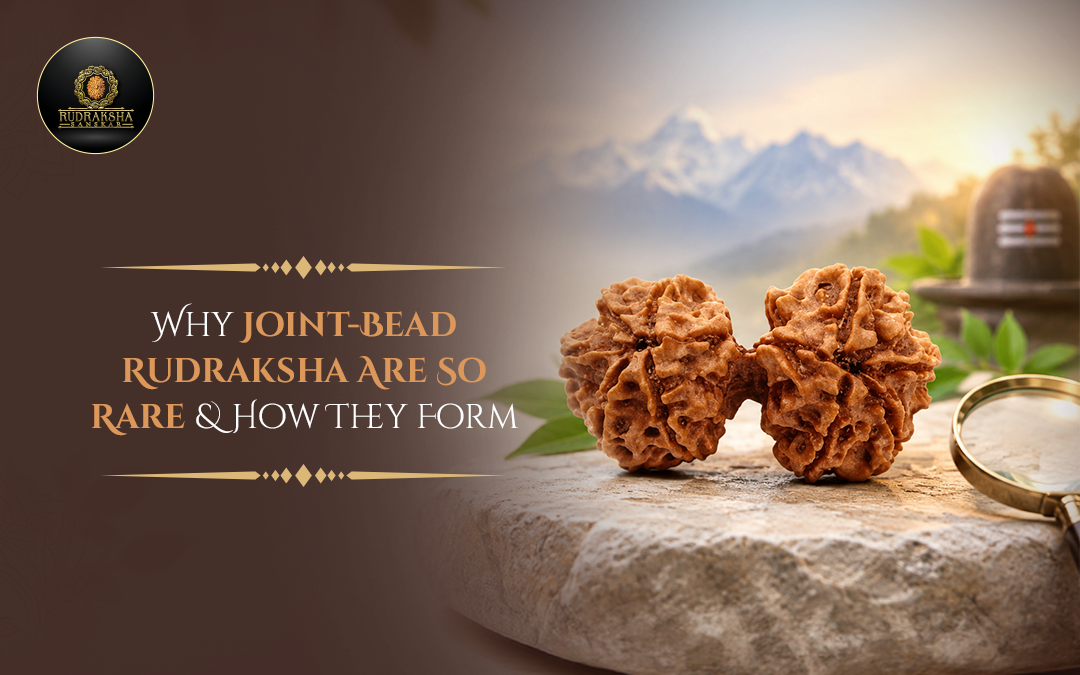
Two bead-like structures may be connected. Three may form a single unusual specimen. Sometimes, a smaller structure appears attached to a larger one.
These rare formations are commonly known as joint-bead Rudraksha.
Examples include Gauri Shankar, Garbh Gauri, Trijuti and Sawar Rudraksha.
Because of their unusual appearance and traditional significance, they often attract considerable interest from collectors and spiritual practitioners.
But why are these formations so uncommon?
And how do they develop naturally?
The answer begins with understanding how an ordinary Rudraksha forms.
How Does a Normal Rudraksha Form?
Rudraksha beads come from trees commonly identified as Elaeocarpus ganitrus.
The tree produces fruits containing a hard, naturally textured inner structure commonly called the Rudraksha bead.
During development, the fruit and its internal structures grow and mature.
After harvesting, the outer fruit pulp is removed to reveal the hard Rudraksha.
Most harvested fruits produce a single, recognisable bead.
Its natural surface divisions are called Mukhi.
These are the grooves used to classify Rudraksha into different Mukhi categories.
However, Mukhi count and joint-bead formation are not the same thing.
A 7 Mukhi Rudraksha has seven natural faces.
A Gauri Shankar Rudraksha is identified by its two naturally connected bead-like structures.
The two classifications describe different physical characteristics.
How Do Naturally Joined Rudraksha Form?
Naturally joined Rudraksha are understood to arise from unusual developmental formations during fruit and seed growth.
Instead of developing as a typical separate bead, two or more bead-like structures may become connected.
Possible explanations include unusual development of the fruit’s internal structures or closely associated developing structures.
However, the exact biological processes responsible for every named joint-bead formation have not been conclusively established.
It would therefore be misleading to claim that all Gauri Shankar, Trijuti or Sawar Rudraksha form through one scientifically proven mechanism.
What matters from a buyer’s perspective is that a genuine specimen has a naturally developed connection rather than an artificial attachment created after harvesting.
1. Gauri Shankar: How Two Rudraksha Become Joined
A Gauri Shankar Rudraksha is recognised by two naturally connected bead-like structures.
Its appearance is traditionally associated with Lord Shiva and Goddess Parvati.
How Does It Form?
The specimen develops with two connected structures rather than the typical single-bead appearance.
The relative sizes, shape and position of these structures can vary.
Some Gauri Shankar Rudraksha appear fairly symmetrical.
Others have noticeable differences between the two parts.
These variations are part of what makes each natural specimen distinctive.
Why Is It Rare?
Most Rudraksha do not develop this unusual double formation.
A genuine Gauri Shankar must have the required natural connection, not simply two ordinary beads placed together.
Larger, well-preserved and clearly formed specimens may attract additional collector interest.
However, there is no universally established percentage describing how frequently natural Gauri Shankar Rudraksha occur.
2. Garbh Gauri: The Unequal Joined Formation
A Garbh Gauri Rudraksha also features two naturally connected structures.
The main distinction is their relative size.
Typically, one part is noticeably larger than the other.
This creates an appearance traditionally interpreted as a mother and child.
How Does It Form?
Like other joint-bead Rudraksha, Garbh Gauri is understood as an unusual natural development.
Its characteristic unequal structure distinguishes it from many Gauri Shankar specimens.
However, the exact developmental mechanism has not been established sufficiently to make detailed claims about how the two differently sized parts originate.
Why Is It Rare?
The formation requires a specific natural appearance.
Not every joined double Rudraksha will be classified as Garbh Gauri.
Its unusual proportions, condition and natural connection contribute to its collector interest.
Garbh Gauri is traditionally associated with motherhood, nurturing and family bonds.
These are spiritual associations, not guarantees of fertility or pregnancy.
3. Trijuti: How Three Rudraksha Become Joined
A Trijuti Rudraksha is identified by three naturally connected bead-like structures.
This makes it visually different from the double formations.
How Does It Form?
A Trijuti develops as an unusual three-part natural structure.
The individual parts may differ in size, orientation and appearance.
Although this is often described commercially as three Rudraksha growing together, the precise botanical mechanism should not be assumed without examination.
Why Is Trijuti Particularly Rare?
A typical Rudraksha does not have three connected bead-like structures.
The unusual three-part formation is one reason Trijuti is considered especially scarce.
Collector interest may also depend on:
- Clearly recognisable three-part structure
- Natural connection
- Overall dimensions
- Surface condition
- Geographic origin
- Authenticity documentation
Trijuti is traditionally associated with Brahma, Vishnu and Shiva, collectively known as the Trimurti.
Its symbolism represents creation, preservation and transformation.
4. Sawar Rudraksha: The Smaller Attached Formation
Sawar Rudraksha is another unusual natural formation.
It is generally recognised by a smaller bead-like structure attached to a larger primary Rudraksha.
Some specimens are described using combinations such as 8+1, referring to the claimed Mukhi composition of their connected parts.
How Does Sawar Form?
Sawar is understood as a naturally developed attached formation.
Unlike a typical symmetrical double Rudraksha, the secondary part is comparatively small.
Its appearance may resemble a small bead emerging from or attached to the larger structure.
The exact developmental pathway responsible for Sawar formations has not been conclusively documented.
Why Is It Rare?
A naturally attached smaller structure is unusual.
Its commercial rarity may depend on the size, natural connection, Mukhi characteristics and condition of the specimen.
However, Sawar and Garbh Gauri can sometimes appear similar.
This is why buyers should understand the specific classification being used rather than relying on appearance alone.
What About Ganesh Rudraksha?
Ganesh Rudraksha is frequently discussed alongside joined-bead formations.
However, it is structurally different.
A Ganesh Rudraksha is recognised by a natural protrusion resembling the trunk of Lord Ganesha.
It does not necessarily contain two connected bead-like structures.
This distinction matters because an unusual surface protrusion and a naturally joined formation are not identical characteristics.
Some specimens described as Ganesh Sawar are claimed to display both a trunk-like protrusion and a smaller attached bead-like structure.
Each feature should be examined individually.
Why Are Joint-Bead Rudraksha So Uncommon?
Several factors contribute to their perceived rarity.
1. Unusual Natural Development
Most Rudraksha develop without these distinctive joined structures.
Joint-bead specimens represent less typical physical formations.
2. Specific Shape Requirements
Not every irregular Rudraksha qualifies as Gauri Shankar, Garbh Gauri, Trijuti or Sawar.
Each category has recognisable characteristics.
3. Condition After Harvesting
A naturally unusual specimen may have cracks, damaged connections or other imperfections.
Well-preserved formations can be more desirable to collectors.
4. Size and Appearance
Larger or particularly well-defined specimens may attract higher prices.
However, size alone does not establish authenticity or spiritual superiority.
5. Collector Demand
Special formations are valued for their appearance, symbolism and scarcity.
Demand can increase their commercial value independently of their physical characteristics.
Natural rarity and market price are related, but they are not identical.
Can Farmers Cultivate Joint-Bead Rudraksha Deliberately?
Rudraksha farmers can cultivate trees and manage their growing conditions.
They can support healthy growth, flowering and fruit production.
However, there is no established cultivation method that reliably produces a chosen natural formation such as Gauri Shankar, Garbh Gauri or Trijuti on demand.
A farmer cannot simply decide that the next harvest will contain a particular number of naturally joined Rudraksha.
This uncertainty is part of what makes these specimens commercially interesting.
The cultivation of Rudraksha trees and the formation of rare individual beads are different processes.
Does a Joint-Bead Rudraksha Have More Spiritual Power?
There is no objective evidence that a naturally joined Rudraksha is automatically more spiritually powerful than a regular bead.
Its significance comes primarily from traditional religious associations.
For example:
Gauri Shankar: Shiva-Parvati unity and harmony.
Garbh Gauri: Motherhood and nurturing.
Trijuti: The Trimurti and interconnected divine functions.
Sawar: Special symbolic interpretations that vary across traditions.
These associations may be meaningful within a person’s spiritual practice.
However, rarity should not be interpreted as proof of greater spiritual effectiveness.
How Can You Tell Whether a Joint-Bead Is Natural?
Because rare formations can command premium prices, authenticity is especially important.
Two genuine Rudraksha can be artificially glued together.
That does not make the resulting specimen a naturally joined Gauri Shankar.
Before purchasing, examine:
- The natural joining area
- Surface texture
- Signs of glue or filler
- Artificial seams
- Tool marks
- Exact specimen photographs
- Appropriate authenticity documentation
For valuable specimens, professional examination is preferable to relying only on photographs.
A certificate should ideally address the claimed natural formation rather than merely identifying the material as Rudraksha.
You can also read the step-by-step Rudraksha authenticity guide for additional verification considerations.
Joint-bead Rudraksha are fascinating because they differ from the typical appearance of an individual Rudraksha.
Gauri Shankar features two naturally connected structures.
Garbh Gauri has a distinctive unequal double formation.
Trijuti is recognised by three connected parts.
Sawar features a smaller bead-like attachment.
Each is valued for its unusual appearance and traditional significance. But the exact natural developmental mechanisms are not fully understood, and reliable occurrence percentages are unavailable.
When you buy rudraksha online, focus on the specimen’s actual structure, condition and authenticity evidence rather than dramatic rarity claims. What makes a genuine joint-bead Rudraksha special is that its unusual formation developed naturally, not that someone gave it an impressive name or price.
FAQs
They are understood to develop through unusual natural growth patterns involving connected bead-like structures. The precise biological mechanisms behind different named formations are not yet conclusively established.
It has an unusual natural double formation that is not typical of most Rudraksha. Its condition, size and natural connection also influence collector interest.
Trijuti is generally considered particularly scarce because of its three-part natural formation. However, reliable universal occurrence rates are unavailable, so an exact rarity comparison cannot be established.
There is no established agricultural method that reliably produces genuine Gauri Shankar formations on demand.
A genuine Sawar is understood to have a naturally developed smaller attached structure. Artificially assembled specimens should not be represented as natural Sawar.
Their significance is based on traditional spiritual symbolism. Natural rarity does not scientifically establish greater spiritual power.