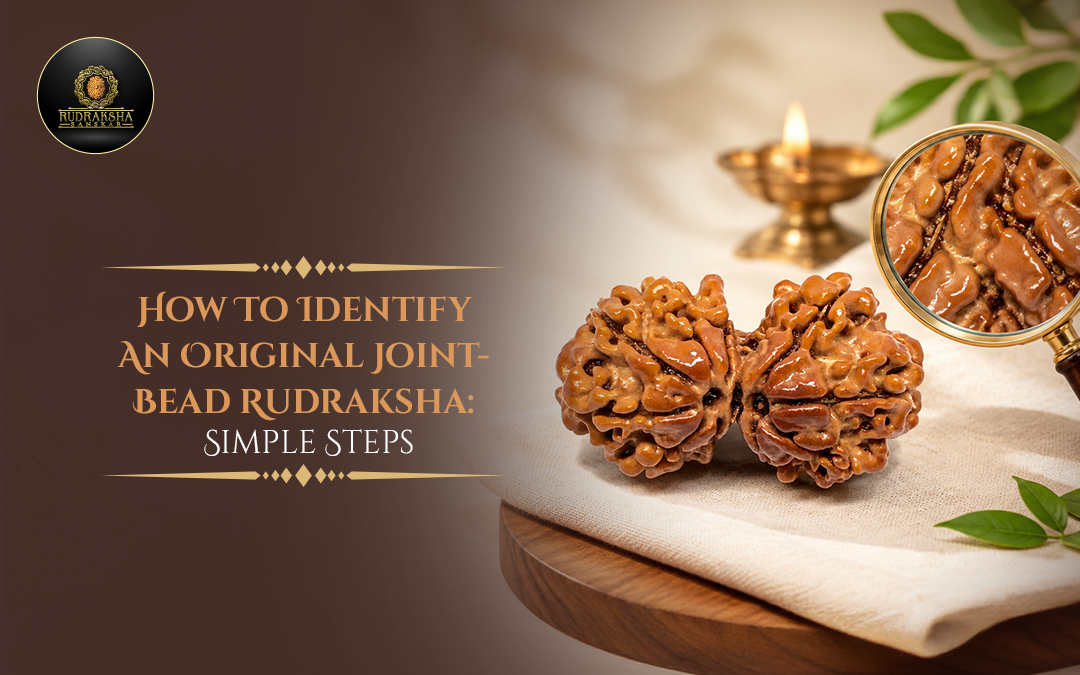
A Gauri Shankar with two naturally joined beads. A rare Trijuti with three connected structures. A Sawar Rudraksha with a smaller bead-like attachment.
These unusual Rudraksha formations can be fascinating.
But they also raise an important question:
How can you tell whether the beads are naturally joined or artificially attached?
Unlike a regular Rudraksha, where the primary concern may be verifying its Mukhi count, a joint-bead Rudraksha requires careful examination of its natural connection.
A convincing appearance alone is not enough.
Here is a practical guide to identifying an original joint-bead Rudraksha before making a purchase.
What Is a Joint-Bead Rudraksha?
A joint-bead Rudraksha is a special formation in which two or more bead-like structures are naturally connected.
Commonly recognised examples include:
- Gauri Shankar: Two naturally joined Rudraksha
- Garbh Gauri: Two joined structures, typically with one noticeably smaller
- Trijuti: Three naturally joined Rudraksha
- Sawar: A smaller bead-like formation attached to a primary Rudraksha
These formations are valued for their unusual natural appearance and traditional spiritual associations.
However, not every Rudraksha with an unusual shape is a joint-bead.
For example, Ganesh Rudraksha is identified by a natural trunk-like protrusion rather than necessarily having a second attached bead.
Understanding the correct formation is the first step toward authentication.
Step 1: Identify Which Formation You Are Buying
Before examining authenticity, establish what the seller claims the specimen to be.
Different formations have different identifying characteristics.
| Formation | Main physical characteristic |
| Gauri Shankar | Two naturally joined bead-like structures |
| Garbh Gauri | Larger and smaller naturally joined structures |
| Trijuti | Three naturally joined structures |
| Sawar | Smaller bead-like attachment on a primary bead |
| Ganesh | Natural trunk-like protrusion, not necessarily joined |
For example, a Gauri Shankar Rudraksha and a Garbh Gauri Rudraksha may both contain two connected structures.
Their classification can depend on the relative sizes and traditional interpretation of those structures.
Similarly, a Sawar may resemble certain unequal joined formations.
Always ask the seller to explain exactly why the specimen belongs to the stated category.
Step 2: Examine the Natural Joining Area
This is the most important physical check.
For a genuine joint-bead formation, the connection should be consistent with natural development.
Look carefully at the point where the structures meet.
Pay attention to:
- Surface continuity
- Natural texture around the joint
- Unusual seams
- Visible adhesive
- Filled gaps
- Signs of carving
- Abrupt changes in surface appearance
An artificially assembled specimen may contain two genuine Rudraksha that have been glued together.
In that situation, the individual beads may be authentic, but the claimed natural joint is not.
That distinction matters.
Two original Rudraksha glued together do not become an original Gauri Shankar.
However, a natural joint does not always look perfectly smooth. Irregularity alone is not proof of manipulation.
Step 3: Check the Surface Texture
Natural Rudraksha have distinctive grooves, ridges and textured surfaces.
When examining a joint-bead specimen, compare the surface characteristics of its connected parts.
Look for suspicious differences such as:
- One section appearing unusually polished
- Artificially sharpened grooves
- Abruptly interrupted textures
- Tool marks
- Areas that appear filled or reconstructed
The goal is not to find two perfectly matching surfaces.
Natural formations are often irregular.
Instead, you want to determine whether the specimen shows evidence of artificial modification.
For valuable Rudraksha, magnified examination by an experienced professional is preferable to relying on photographs alone.
Step 4: Look for Glue, Filler or Artificial Repairs
Some manipulated specimens may be assembled using adhesives or filler materials.
Possible warning signs include:
Visible glue residue: Material around the connection that does not resemble the natural surface.
Unnatural seams: A joining line that appears inconsistent with the surrounding structure.
Filled gaps: Areas that seem deliberately covered or reconstructed.
Different surface finishes: One section looks treated while another retains its natural texture.
However, these observations are warning signs, not definitive laboratory conclusions.
A carefully altered specimen may not reveal obvious glue in ordinary photographs.
That is why expensive joint-bead Rudraksha should receive appropriate professional examination.
Step 5: Examine the Formation From Every Angle
One photograph is rarely enough to evaluate a rare Rudraksha.
A front-facing image may make an artificial connection appear convincing.
Ask for clear photographs showing:
- Front view
- Back view
- Left side
- Right side
- Top view
- Bottom view
- Close-up of the natural joint
For a Trijuti, the photographs should clearly show all three connected structures.
For Sawar, the smaller attached formation should be visible from multiple angles.
If possible, request a short, continuous video showing the bead being rotated slowly.
This can help you understand its three-dimensional structure.
The exact specimen matters more than a beautiful catalogue photograph.
Step 6: Count the Mukhi on Each Structure
The Mukhi count remains important, even when the main feature is a natural joint.
For example, a Sawar may be marketed using a combination such as 8+1.
That claim should be examined rather than accepted automatically.
Similarly, joined formations may have different Mukhi counts across their connected parts.
Ask whether the seller has identified:
- The Mukhi count of the primary structure
- The Mukhi count of the secondary structure, where applicable
- The natural surface divisions
- Any uncertainty in the classification
Not every joint-bead formation follows one fixed Mukhi combination.
The specimen should be assessed according to its actual characteristics.
Step 7: Understand What an X-Ray Can and Cannot Prove
X-ray examination can provide useful supporting information about internal structures.
For certain rare Rudraksha, it may help specialists assess internal compartments or identify unusual construction.
However, there is an important limitation.
An X-ray alone does not conclusively establish that an external joint developed naturally.
Authentication may require surface examination, magnification and other appropriate techniques.
A stronger assessment considers both the external formation and supporting internal evidence.
Do not purchase an expensive joined Rudraksha solely because the seller displays an X-ray image.
Make sure the image belongs to the exact specimen being offered.
Step 8: Check the Certificate Carefully
A certificate can be useful, but only if it contains relevant information.
For a joint-bead Rudraksha, look for details such as:
- Specimen photographs
- Dimensions
- Weight
- Formation type
- Natural Mukhi count
- Surface examination findings
- Certificate number
- Date of examination
- Supporting imaging, where available
Most importantly, check what the report actually confirms.
A certificate identifying a specimen as Rudraksha does not necessarily establish that its joined formation is natural.
These are separate questions.
A useful report should clearly explain the scope of its examination.
For broader guidance, read how to identify an original Rudraksha.
Step 9: Be Extra Careful With Trijuti and Rare Sawar
Some formations deserve particularly careful inspection because of their unusual structures and potential collector value.
Trijuti Rudraksha
A genuine Trijuti Rudraksha is understood to contain three naturally joined structures.
When evaluating one, inspect all joining areas.
Do not assume that a specimen is natural simply because three bead-like structures are visible.
Sawar Rudraksha
Sawar requires attention to the smaller attached structure.
Check whether it appears naturally connected or artificially fixed to the primary bead.
Some market classifications overlap visually with other joined formations, so a clear explanation of the claimed type is important.
Ganesh Sawar Rudraksha
A Ganesh Sawar is claimed to combine a natural trunk-like protrusion with a Sawar-type attachment.
Both characteristics should be examined separately.
One genuine-looking feature does not automatically authenticate the other.
Step 10: Don’t Use Water or Copper Tests as Proof
You may come across traditional home tests claiming that an original Rudraksha will sink in water or rotate between copper coins.
These are not reliable methods for authenticating natural joined formations.
A glued specimen may sink in water.
A genuine specimen may behave differently depending on its physical condition.
Neither test can reliably establish whether two structures grew together naturally.
For valuable joint-bead Rudraksha, proper physical examination is far more informative than simple home demonstrations.
A Quick Checklist Before Buying
Before purchasing a rare joint-bead Rudraksha, ask yourself:
- Do I know the exact formation being offered?
- Have I seen photographs of the actual specimen?
- Is the joining area visible from multiple angles?
- Are there signs of glue, filler or artificial modification?
- Has the natural surface been examined?
- Are the claimed Mukhi counts documented?
- Does the certificate address the natural formation?
- Do the certificate and photographs match the same specimen?
- Can the seller explain the basis for the price?
If several of these questions remain unanswered, consider seeking further verification before purchasing.
FAQs
Examine the natural connection between the two bead-like structures. Look for surface continuity and signs of artificial joining. For expensive specimens, obtain appropriate professional examination and documentation.
Yes. Two authentic individual beads can be artificially attached. This does not make the resulting formation a naturally joined Gauri Shankar.
Verify that all three bead-like structures appear naturally connected. Inspect each joining area and request specimen-specific documentation.
Not necessarily. Both may contain unequal connected structures, but their market classifications and traditional interpretations differ. The exact formation should be evaluated.
X-ray may provide supporting structural information, but it should not be treated as conclusive proof of natural external joining. Surface examination remains essential.
No. The certificate’s reliability depends on the issuing laboratory, examination methods, findings and whether it corresponds to the exact specimen.