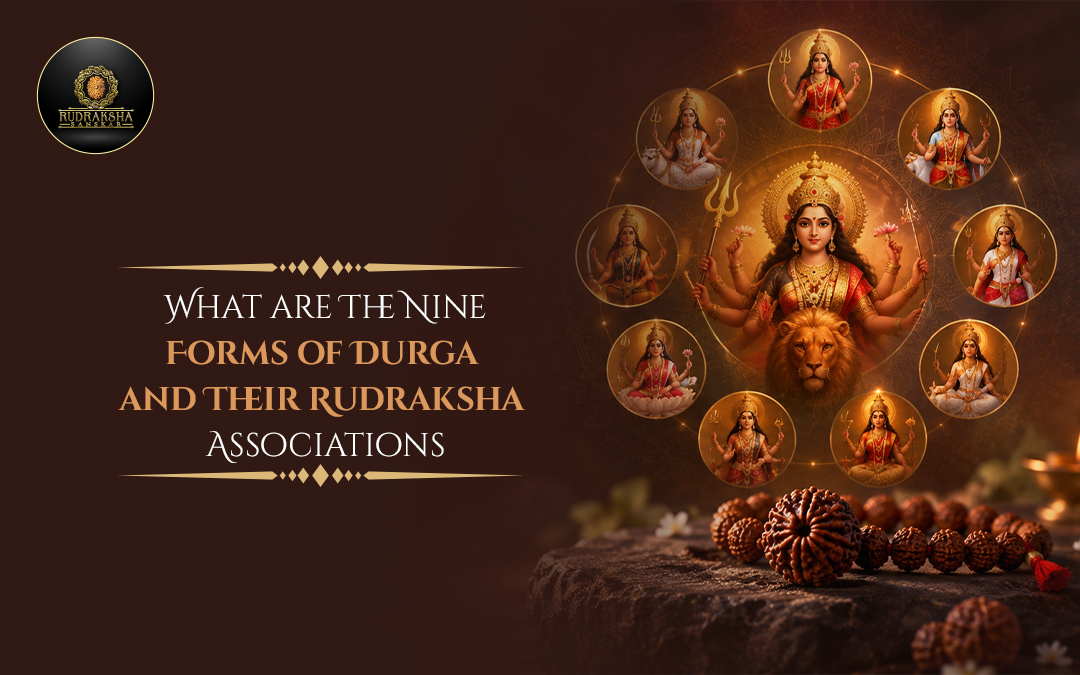
Every night of Navratri celebrates a different form of Goddess Durga. From the strength of Shailaputri to the wisdom of Siddhidatri, each form represents a distinct aspect of divine feminine energy.
But have you ever wondered how these nine goddesses connect with Rudraksha?
The answer begins with the 9 Mukhi Rudraksha, a bead traditionally associated with Goddess Durga and her nine forms, collectively known as Navdurga.
However, there is an important difference between worshipping Navdurga through a Rudraksha and assigning a separate Mukhi to every goddess.
Let’s explore the nine forms of Durga, their traditional meanings, and how Rudraksha fits into their worship.
1. What Are the Nine Forms of Goddess Durga?
The nine forms of Goddess Durga are collectively called Navdurga. Each form is worshipped on a particular day of Navratri and represents different qualities of Shakti, the divine feminine power.
The nine forms are:
- Shailaputri
- Brahmacharini
- Chandraghanta
- Kushmanda
- Skandamata
- Katyayani
- Kalaratri
- Mahagauri
- Siddhidatri
Together, these forms represent courage, discipline, compassion, wisdom, spiritual transformation and fulfilment.
Navratri provides an opportunity for devotees to reflect on these qualities through prayer, fasting, meditation and traditional worship.
2. The Nine Forms of Durga and Their Spiritual Significance
Day 1: Maa Shailaputri – Strength and Stability
Maa Shailaputri is the first form of Navdurga. Her name means daughter of the mountain, referring to her identity as the daughter of Himalaya.
She is traditionally depicted riding a bull, carrying a trident and a lotus.
Her symbolism centres on strength, stability and devotion.
Rudraksha connection: Devotees may use Rudraksha during prayers to Shailaputri as part of their Shiva-Shakti worship. The 9 Mukhi is associated with Navdurga collectively, rather than exclusively with Shailaputri.
Her worship reminds devotees to establish a steady foundation for their spiritual practice.
Day 2: Maa Brahmacharini – Discipline and Devotion
Maa Brahmacharini represents spiritual dedication, patience and self-discipline.
She is commonly depicted carrying a rosary and a water pot, reflecting her life of austerity and devotion.
Her story is closely connected with Goddess Parvati’s penance to attain Lord Shiva as her husband.
Rudraksha connection: Rudraksha malas are traditionally used for mantra repetition and meditation. A 5 Mukhi Rudraksha mala may be used for regular Japa, although it is not an exclusive or universally prescribed bead for Brahmacharini.
Her example encourages consistency in spiritual practice.
Day 3: Maa Chandraghanta – Courage and Protection
Maa Chandraghanta is recognised by the crescent-shaped moon on her forehead, resembling a bell.
She is depicted as a powerful goddess who combines a peaceful nature with readiness to confront destructive forces.
Her traditional qualities include courage, vigilance and protection.
Rudraksha connection: The Durga association of 9 Mukhi Rudraksha reflects similar themes of courage and protective divine energy.
This is a symbolic connection, not a promise that wearing the bead prevents accidents or other dangers.
Day 4: Maa Kushmanda – Creation and Vitality
Maa Kushmanda is associated with cosmic creation and the life-giving energy of the universe.
In popular Navdurga traditions, she is described as illuminating the cosmos through her divine radiance.
She represents creativity, vitality and the beginning of new possibilities.
Rudraksha connection: Devotees who associate Rudraksha with Shakti may include the 9 Mukhi in their worship of Navdurga. However, there is no universally established Mukhi specifically assigned to Kushmanda.
Her symbolism encourages gratitude for life and the energy behind creation.
Day 5: Maa Skandamata – Compassion and Motherhood
Maa Skandamata is the mother of Skanda, also known as Kartikeya.
She is traditionally depicted holding the young Skanda and is associated with maternal affection, nurturing and compassion.
Her form highlights the protective and caring aspects of divine motherhood.
Rudraksha connection: Some devotees may find the symbolism of Garbh Gauri Rudraksha meaningful because of its traditional mother-child association.
However, Garbh Gauri is not a universally prescribed Rudraksha for Skandamata worship.
The connection is thematic rather than a fixed scriptural assignment.
Day 6: Maa Katyayani – Determination and Divine Courage
Maa Katyayani is a warrior form of Goddess Durga.
She is associated with determination, courage and the defeat of harmful forces.
Her worship is particularly significant in traditions celebrating Durga’s victory over Mahishasura.
Rudraksha connection: The 9 Mukhi Rudraksha is commonly associated with Goddess Durga’s strength and courage, making its symbolism relevant to Katyayani worship.
The bead can serve as a devotional reminder of determination, but it does not guarantee success over personal or professional challenges.
Day 7: Maa Kalaratri – Fearlessness and Transformation
Maa Kalaratri is one of the most formidable forms of Navdurga.
Her dark appearance and fierce imagery represent the destruction of ignorance, fear and destructive forces.
Despite her fearsome form, she is revered as an auspicious and protective goddess.
Rudraksha connection: The 9 Mukhi’s association with Durga and Shakti is often interpreted through qualities such as fearlessness and inner strength.
Certain astrological traditions also associate 9 Mukhi with Ketu, although this is separate from the Navdurga connection.
Her worship encourages devotees to confront fear with faith and awareness.
Day 8: Maa Mahagauri – Purity and Peace
Maa Mahagauri represents purity, tranquillity and spiritual renewal.
She is traditionally depicted in white and is associated with serenity and compassion.
Her form symbolises the peaceful aspect of divine feminine energy.
Rudraksha connection: A Rudraksha mala may be used during prayers and meditation dedicated to Mahagauri. The 9 Mukhi remains a general Navdurga-associated bead rather than a specifically established Mahagauri Rudraksha.
Her worship offers an opportunity to reflect on forgiveness, clarity and inner peace.
Day 9: Maa Siddhidatri – Wisdom and Spiritual Fulfilment
Maa Siddhidatri is the ninth form of Navdurga.
Her name refers to the giver of Siddhis, or spiritual accomplishments, within Hindu religious traditions.
She represents divine wisdom, fulfilment and spiritual completeness.
Rudraksha connection: The 9 Mukhi Rudraksha may be worn as a devotional symbol of Navdurga’s combined qualities, including those represented by Siddhidatri.
However, wearing a Rudraksha does not guarantee supernatural abilities or spiritual accomplishments.
Her worship reminds devotees that wisdom and spiritual growth require dedication.
3. How Is 9 Mukhi Rudraksha Connected With Navdurga?
The 9 Mukhi Rudraksha is commonly associated with Goddess Durga and the nine forms of Navdurga in contemporary Rudraksha traditions.
The connection is based on the bead’s nine natural faces and their devotional interpretation.
The bead is traditionally linked with qualities such as:
- Courage and determination
- Devotion to Goddess Durga
- Spiritual confidence
- Strength during difficult circumstances
- Protective symbolism
- Connection with Shakti worship
However, the nine physical grooves should not be interpreted as scientifically verified representations of nine divine energies.
Their religious significance comes from tradition and belief.
Does Each Form of Durga Have a Different Rudraksha?
There is no single, universally accepted system assigning a specific Mukhi to each of the nine forms of Durga.
Some modern spiritual guides suggest different Rudraksha for different goddesses based on qualities, planetary associations or personal interpretations.
These recommendations can vary considerably.
For example, connecting Skandamata with Garbh Gauri because of motherhood symbolism is understandable, but it should not be presented as an established rule from ancient scripture.
For devotees seeking a simple association with Navdurga collectively, the 9 Mukhi is among the most commonly discussed options.
4. Can You Wear 9 Mukhi Rudraksha During Navratri?
Yes. Devotees who follow Rudraksha traditions may choose to begin wearing a 9 Mukhi during Navratri.
The festival is considered an auspicious period for worshipping Goddess Durga.
A simple devotional approach may include:
- Selecting an authentic 9 Mukhi Rudraksha.
- Cleaning and handling the bead carefully.
- Offering prayers to Goddess Durga.
- Reciting a mantra according to your family or spiritual tradition.
- Wearing the bead comfortably or keeping it in a suitable place for worship.
A commonly recited Durga mantra is:
ॐ दुं दुर्गायै नमः
Om Dum Durgayai Namah.
There is no need to assume that elaborate commercial rituals are compulsory.
Different families and spiritual lineages may follow different practices.
5. How to Choose an Original 9 Mukhi Rudraksha
Before purchasing a 9 Mukhi Rudraksha, verify its physical characteristics.
The bead should have nine naturally developed facial divisions.
Pay attention to:
Natural Mukhi lines: Check that the nine grooves are genuine rather than artificially carved.
Surface condition: Look for suspicious alterations, cracks or repairs.
Exact photographs: Request clear images of the actual specimen.
Origin: Nepali and Indonesian Rudraksha may differ in average size and surface appearance, but both can be authentic.
Documentation: Check whether the certificate matches the specimen and clearly explains the examination performed.
Seller transparency: Avoid claims that the bead guarantees protection, removes all obstacles or produces instant results.
For additional guidance, read how to identify an original Rudraksha.
The nine forms of Goddess Durga represent a journey through strength, discipline, courage, compassion, transformation and wisdom. Each form offers a different perspective on the qualities devotees seek to develop through spiritual practice.
The 9 Mukhi Rudraksha is associated with Navdurga in several contemporary traditions, making it a meaningful devotional symbol for some worshippers.
However, the connection should not be confused with a universally established system assigning a different Mukhi to each goddess. When you buy rudraksha online, choose an authentic bead and understand the tradition behind its significance.
FAQs
The nine forms are Shailaputri, Brahmacharini, Chandraghanta, Kushmanda, Skandamata, Katyayani, Kalaratri, Mahagauri and Siddhidatri. Together, they are known as Navdurga.
The 9 Mukhi Rudraksha is commonly associated with Goddess Durga and Navdurga collectively in several contemporary Rudraksha traditions.
There is no universally accepted one-to-one Mukhi assignment for all nine forms. Some suggested combinations are modern devotional interpretations rather than fixed scriptural rules.
Yes. Devotees may begin wearing it on the first day or another personally meaningful occasion, according to their spiritual tradition.
Yes. Certain astrological traditions associate 9 Mukhi with Ketu. This association is distinct from its devotional connection with Goddess Durga.
Yes. There is no universal restriction preventing women from wearing 9 Mukhi Rudraksha. Individual family or lineage customs may vary.