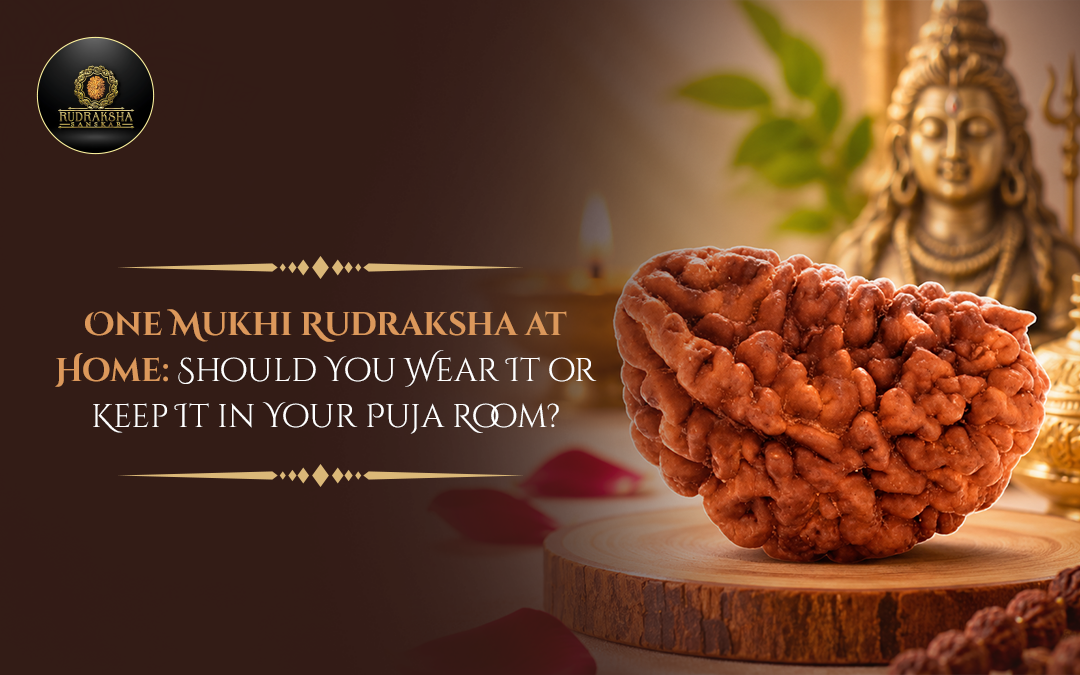
The One Mukhi Rudraksha holds a special place in Hindu spiritual traditions because of its association with Lord Shiva. Its rarity, religious significance and premium pricing make it one of the most sought-after Rudraksha varieties.
However, after purchasing a One Mukhi Rudraksha, many devotees face an important question: Should you wear it every day or keep it in your home puja room?
Both practices are followed in different devotional traditions. Some people prefer wearing Rudraksha as a personal symbol of faith, while others place rare beads near a Shiva Lingam or within their home temple.
Neither approach is universally superior. The right choice depends on your spiritual practice, family customs, the bead’s authenticity and how safely you can maintain it.
This guide explains the religious significance, practical differences, placement considerations and common rules associated with keeping or wearing One Mukhi Rudraksha.
1. What Is One Mukhi Rudraksha?
One Mukhi Rudraksha, also called Ek Mukhi or 1 Mukhi Rudraksha, refers to a Rudraksha specimen described as having one natural facial division.
The Sanskrit word Eka means one, while Mukhi refers to the natural faces or divisions of a Rudraksha bead.
The 1 Mukhi Rudraksha is traditionally associated with Lord Shiva.
In Shaiva devotional interpretations, it represents unity, spiritual awareness and devotion to Shiva.
Why Is It Considered Rare?
Genuine one-faced Rudraksha specimens are highly sought after, particularly those identified as naturally formed Elaeocarpus ganitrus beads.
However, different botanical specimens are marketed under the Ek Mukhi name, including certain elongated or crescent-shaped varieties.
For this reason, buyers should verify the exact identity of the specimen rather than relying on its commercial name alone.
Its rarity also makes proper handling and storage particularly important.
2. Can You Keep One Mukhi Rudraksha in Your Puja Room?
Yes. Keeping One Mukhi Rudraksha in a home puja room is a common devotional choice.
Many devotees prefer placing rare Rudraksha specimens in their home temple rather than wearing them during everyday activities.
A puja room provides a dedicated location for prayer, meditation and religious observances.
The bead may be placed near an image of Lord Shiva, a Shiva Lingam or another appropriate sacred arrangement according to family tradition.
Why Do Some Devotees Prefer Puja Room Placement?
There are several reasons.
Religious significance: The bead is associated with Lord Shiva, making it meaningful within a Shiva-focused worship space.
Protection from physical damage: A rare bead may be less exposed to moisture, friction and accidental impact when securely stored.
Convenience: Devotees can include the bead in daily prayers without wearing it continuously.
Family worship: Keeping it in the puja room allows the household to incorporate it into shared devotional practices.
These are practical and religious considerations rather than scientifically established supernatural benefits.
3. Can You Wear One Mukhi Rudraksha Every Day?
Yes. Many devotees wear Rudraksha as a pendant or necklace during daily activities.
There is no universally accepted rule requiring every One Mukhi Rudraksha to remain permanently in a puja room.
In Shaiva traditions, Rudraksha wearing itself is an established devotional practice.
Why Do People Wear It?
Some devotees choose to wear One Mukhi Rudraksha as:
- A personal symbol of devotion to Lord Shiva
- A reminder to practise spiritual discipline
- A connection to their daily prayer routine
- A traditional religious ornament
The bead’s spiritual meaning is rooted in faith and tradition.
Wearing it does not scientifically guarantee wealth, improved health, professional success or protection from misfortune.
Is Daily Wearing Practical?
That depends on the specimen.
A rare, expensive bead may require a protective pendant setting and careful handling.
If your daily activities involve chemicals, heavy physical work or frequent exposure to moisture, keeping the bead in your puja room may be more practical.
4. Wearing vs Keeping One Mukhi Rudraksha in a Puja Room
Both approaches have advantages.
| Factor | Wearing One Mukhi | Keeping It in a Puja Room |
| Main purpose | Personal devotional wear | Home worship and prayer |
| Daily accessibility | Remains with the wearer | Available during puja |
| Physical protection | Depends on pendant and activities | Easier to protect when stored properly |
| Maintenance | Requires regular inspection | Requires careful storage and occasional cleaning |
| Suitable for rare specimens | Yes, with precautions | Often a practical choice |
| Religious significance | Associated with Shiva devotion | Associated with Shiva worship |
Which Option Is Better?
For someone who wants a personal devotional reminder throughout the day, wearing the bead may be preferable.
For someone who owns a particularly rare or valuable specimen, puja room placement may reduce the risk of accidental damage.
Neither option has been scientifically shown to produce greater spiritual benefits.
5. Where Should You Place One Mukhi Rudraksha in Your Puja Room?
If you choose to keep One Mukhi Rudraksha at home, select a clean, secure and dry location.
Near Lord Shiva’s Image or Shiva Lingam
Many devotees place Rudraksha near an image or representation of Lord Shiva.
This is consistent with the bead’s traditional religious association.
On a Clean Cloth or Small Tray
A clean cloth, wooden platform or suitable tray can help keep the bead away from dust and abrasive surfaces.
Ensure that the surface is dry.
Inside a Protective Container
For valuable specimens, a clean protective box can be useful when the bead is not being used for worship.
Avoid trapping moisture inside the container.
Should You Keep It in the Northeast Direction?
Some Vastu traditions favour the northeast, or Ishanya, direction for prayer spaces.
However, there is no universally mandatory rule that a One Mukhi Rudraksha must be placed in the northeast corner.
The suitability of the location depends on household arrangements and religious customs.
A clean, accessible and safe puja area is a sensible choice.
6. How to Perform Puja for One Mukhi Rudraksha at Home
Devotees may include One Mukhi Rudraksha in their regular Shiva worship.
A simple procedure is often sufficient.
Step 1: Prepare the Puja Area
Clean the worship space and place the bead on a suitable cloth or tray.
Step 2: Offer Prayers to Lord Shiva
You may offer flowers or light a diya according to your family tradition.
Keep the Rudraksha away from direct flames, excessive heat and substances that could damage it.
Step 3: Chant a Shiva Mantra
A commonly recited mantra is:
ॐ नमः शिवाय
Om Namah Shivaya.
You may chant it 11, 21 or 108 times according to your devotional routine.
Step 4: Practise Meditation or Prayer
Spend a few minutes in quiet reflection or Shiva-focused meditation.
Step 5: Store the Bead Safely
After completing the puja, return the bead to its designated location.
Avoid unnecessary handling.
Important: Different spiritual lineages may prescribe additional rituals. There is no single universally compulsory puja procedure for all One Mukhi Rudraksha owners.
7. Which Day Is Best to Place One Mukhi Rudraksha in Your Home Temple?
Monday is traditionally associated with Lord Shiva.
For this reason, many devotees choose Monday to begin wearing or worshipping Rudraksha.
Other meaningful occasions include Mahashivratri and Mondays during the month of Shravan.
However, there is no universally accepted rule that One Mukhi Rudraksha can only be placed in a puja room on these days.
If your family follows a particular Panchang or religious lineage, you may observe its preferred timing.
Otherwise, you can incorporate the bead into your regular devotional practice without waiting for a special date.
8. Can You Keep One Mukhi Rudraksha Near a Shiva Lingam?
Yes. Some devotees keep Rudraksha near a Shiva Lingam as part of Shiva worship.
However, care is important when performing Abhishek or other rituals involving liquids.
Should You Pour Milk or Water Directly on the Bead?
Some devotional practices involve washing or offering liquids to sacred objects.
Nevertheless, repeated or prolonged exposure to milk, water, oils and other substances can affect a natural Rudraksha specimen.
Milk residue can also create hygiene and maintenance problems.
For an expensive One Mukhi bead, it may be preferable to place it beside the Shiva Lingam rather than repeatedly immersing it in liquids.
Follow your religious customs while taking reasonable steps to preserve the bead.
9. Can You Keep One Mukhi Rudraksha in Your Bedroom?
Some households do not have a separate puja room.
In such situations, a clean prayer shelf or secure storage location within another room may be appropriate.
There is no scientifically established evidence that keeping Rudraksha in a bedroom causes harm or attracts negative energy.
Some religious traditions prefer that sacred objects be stored in a designated worship area.
Others allow more flexibility.
If your family follows particular placement customs, you may continue observing them.
The main practical considerations are cleanliness, safety and protection from damage.
10. Should You Wear One Mukhi Rudraksha During Sleep or Bathing?
Different traditions have different views on continuous Rudraksha wearing.
Some devotees wear their beads throughout the day and night.
Others remove them during bathing, sleeping or physically demanding activities.
During Sleep
Removing an expensive pendant before sleeping can reduce the risk of pulling, breakage or discomfort.
During Bathing
Avoid prolonged exposure to soap, shampoo and moisture.
If you remove the bead, place it in a clean, dry location.
During Exercise or Physical Work
Remove the bead when there is a significant risk of impact, entanglement or damage.
These precautions concern physical preservation rather than spiritual restrictions.
11. Is One Mukhi Rudraksha Better for Home Worship Than 5 Mukhi Rudraksha?
Both varieties have established roles in Shaiva devotional traditions.
One Mukhi Rudraksha is associated with Lord Shiva and is especially sought after because of its rarity.
The 5 Mukhi Rudraksha is traditionally associated with Kalagni Rudra and is widely used for mantra Japa.
Which Should You Choose?
If your main purpose is regular mantra chanting, a 5 Mukhi mala may be more practical and affordable.
If you specifically wish to keep a One Mukhi specimen as a devotional object in your home temple, that is also a valid personal choice.
A higher price or rarer Mukhi count does not automatically make one bead spiritually superior.
12. Important Rules for Keeping One Mukhi Rudraksha at Home
A few simple practices can help preserve your Rudraksha.
Keep it clean: Remove dust gently and avoid harsh cleaning products.
Store it in a dry place: Excessive moisture may affect the natural bead.
Handle it carefully: Avoid dropping, scratching or repeatedly pulling the specimen.
Keep it away from small children: Loose beads may create choking hazards.
Avoid unnecessary restrictions: Not every online rule about Rudraksha placement is supported by all Hindu traditions.
Verify authenticity: A rare and expensive specimen should be properly examined before purchase.
For detailed buying guidance, read how to identify an original Rudraksha.
For rare and valuable beads, keeping them securely in a puja room may offer practical advantages. For devotees who prefer a personal reminder of Shiva throughout the day, wearing the bead may be more meaningful.
If you plan to buy rudraksha online, prioritise authenticity, proper identification and careful handling.
FAQs
Both are accepted devotional approaches in different traditions. Wearing may suit personal daily practice, while puja room placement can help protect a rare specimen.
Yes. Many devotees place Rudraksha near Lord Shiva’s image or Shiva Lingam. Protect the bead from excessive moisture during Abhishek rituals.
Some Vastu traditions favour the northeast direction for worship spaces. However, no universally mandatory direction applies to every Rudraksha owner.
Yes. You may keep it in your home temple and include it in regular prayers without wearing it as jewellery.
Some spiritual traditions associate Rudraksha with auspiciousness. However, there is no reliable scientific evidence that placing a bead in the home guarantees wealth or financial success.