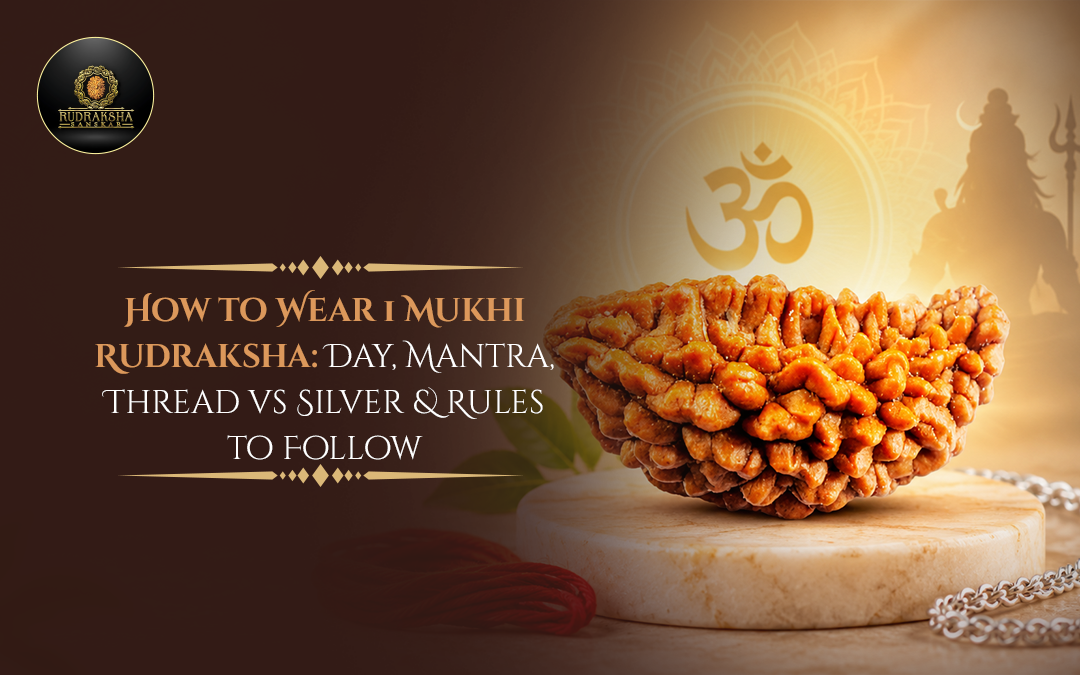
The 1 Mukhi Rudraksha is among the most sought-after Rudraksha varieties because of its traditional association with Lord Shiva. Known for having a single natural face, it holds special significance in Shaiva devotional practices.
However, people purchasing this rare bead often have several questions. Which day is best to wear it? What mantra should you chant? Is a red thread suitable, or should you choose silver? Are there any restrictions after wearing it?
Understanding how to wear 1 Mukhi Rudraksha involves more than selecting an auspicious day. Authenticity, traditional customs, proper handling and personal devotional practices are equally important.
This guide explains the recommended wearing day, commonly used mantras, thread and silver options, and the rules devotees should understand before wearing a 1 Mukhi Rudraksha.
1. What Is 1 Mukhi Rudraksha?
A 1 Mukhi Rudraksha is a Rudraksha specimen with one natural facial division, known as a Mukhi.
The Sanskrit word Mukhi means face, referring to the natural structural divisions visible on Rudraksha beads.
The 1 Mukhi Rudraksha is traditionally associated with Lord Shiva.
In several contemporary spiritual interpretations, it represents unity, self-awareness and devotion to Shiva.
Why Is 1 Mukhi Rudraksha Considered Special?
One-faced Rudraksha specimens are highly sought after in the religious and collector markets.
Their limited availability contributes to high prices and makes authentication especially important.
However, buyers should understand that rarity does not automatically establish stronger spiritual effects.
The significance of 1 Mukhi Rudraksha comes from its religious association with Lord Shiva, rather than scientifically proven supernatural properties.
2. Which Day Is Best to Wear 1 Mukhi Rudraksha?
Monday is one of the most commonly recommended days for wearing 1 Mukhi Rudraksha.
In Hindu traditions, Monday is associated with Lord Shiva.
Since the 1 Mukhi Rudraksha is connected with Shiva worship, many devotees consider Monday a meaningful day to begin wearing it.
Other Auspicious Occasions
Some devotees also choose:
- Mahashivratri
- Shravan Mondays
- Pradosh-related Shiva worship
- Other auspicious occasions recommended by their spiritual teacher
These dates may carry religious significance, but there is no single universally mandatory wearing day for every devotee.
What Is the Best Time to Wear It?
Many practitioners prefer the morning, after bathing and completing their regular prayers.
Some traditions recommend Brahma Muhurta or another auspicious period.
However, exact Muhurat requirements vary between religious lineages.
If your family follows a particular Panchang, you may consult it for a locally appropriate time.
Practical recommendation: Monday morning is a simple traditional choice, but sincere devotional practice is not restricted to one particular hour.
3. Which Mantra Should You Chant for 1 Mukhi Rudraksha?
Mantra recitation is an important part of Rudraksha worship in many Shaiva traditions.
For 1 Mukhi Rudraksha, the most widely recognised and accessible Shiva mantra is:
ॐ नमः शिवाय
Om Namah Shivaya.
This mantra expresses reverence for Lord Shiva.
Other Mantras Associated With 1 Mukhi Rudraksha
Some contemporary Rudraksha traditions recommend:
ॐ ह्रीं नमः
Om Hreem Namah.
This is commonly presented as a Mukhi-specific mantra in certain modern Rudraksha guides.
However, mantra assignments can vary between texts, teachers and spiritual lineages.
It should not be assumed that every tradition prescribes exactly the same mantra for 1 Mukhi Rudraksha.
How Many Times Should You Chant?
Devotees may choose to recite a mantra:
- 11 times
- 21 times
- 108 times
These are commonly used devotional counts, not universal requirements.
If you have received specific instructions from a guru, those may take precedence within your tradition.
4. How to Wear 1 Mukhi Rudraksha for the First Time
You can follow a simple devotional process when beginning to wear 1 Mukhi Rudraksha.
Step 1: Verify the Rudraksha
Before performing any ritual, confirm that the bead is genuine.
One-faced Rudraksha is particularly vulnerable to misleading commercial claims because of its rarity and value.
Request clear specimen photographs and credible authentication documentation.
Step 2: Clean the Bead Gently
If cleaning is necessary, use a soft cloth and an appropriate gentle method.
Avoid prolonged soaking, strong chemicals or abrasive cleaning.
The objective is to remove surface dirt without damaging the natural structure.
Step 3: Prepare a Clean Prayer Space
Choose a quiet location in your home temple or another suitable worship area.
You may place the Rudraksha on a clean cloth.
Step 4: Offer Prayers to Lord Shiva
Light a diya or offer flowers if these practices are part of your family tradition.
Keep the bead away from direct flames and substances that may damage it.
Step 5: Chant the Mantra
Recite Om Namah Shivaya or another mantra followed in your spiritual lineage.
You may complete 11, 21 or 108 repetitions according to your preference.
Step 6: Wear the Rudraksha
After prayer, wear the bead using a suitable thread or pendant setting.
Ensure that the fitting is comfortable and does not damage the specimen.
There is no universally mandatory consecration procedure followed by all Rudraksha devotees.
5. Thread vs Silver: Which Is Better for 1 Mukhi Rudraksha?
One of the most common questions is whether 1 Mukhi Rudraksha should be worn in a thread or a silver pendant.
Both methods are used in contemporary devotional practices.
The choice depends on comfort, appearance, durability and personal religious preference.
Wearing 1 Mukhi Rudraksha in a Thread
Some devotees prefer a cotton or silk thread.
Red, yellow and white threads are commonly used in different religious contexts.
A thread offers a simple, traditional appearance.
However, threads can weaken through moisture, friction and daily wear.
Regular inspection is important, especially when wearing an expensive specimen.
Wearing 1 Mukhi Rudraksha in Silver
Silver pendants are popular because they can provide a more durable mounting arrangement.
A properly designed silver setting may also help protect the bead from unnecessary handling.
However, the setting should not require drilling, cutting or damaging the natural Mukhi structure.
Thread vs Silver Comparison
| Factor | Thread | Silver pendant |
| Appearance | Simple and traditional | Decorative and structured |
| Cost | Generally affordable | Usually more expensive |
| Durability | Requires regular replacement | Depends on fitting quality |
| Comfort | Lightweight | Depends on design |
| Bead protection | Limited | May offer better protection |
| Spiritual superiority | Not established | Not established |
Is Silver Compulsory for 1 Mukhi Rudraksha?
No universally accepted rule requires every 1 Mukhi Rudraksha to be worn in silver.
Likewise, there is no established scientific evidence that silver makes Rudraksha more spiritually effective.
For a rare and valuable bead, choose whichever mounting method offers the best balance of security, comfort and preservation.
6. Can You Wear 1 Mukhi Rudraksha Around Your Neck?
Yes. Many devotees wear Rudraksha as a necklace or pendant.
A 1 Mukhi may be worn close to the chest according to personal preference and family custom.
However, there is no universal requirement that it must touch the skin or remain at a precise height.
A well-fitted pendant should be comfortable and secure.
Avoid heavy settings or tight cords that may cause irritation.
For children, necklaces and loose beads may present choking or strangulation hazards and require particular caution.
7. What Are the Rules for Wearing 1 Mukhi Rudraksha?
Different spiritual traditions follow different rules concerning Rudraksha.
The following considerations help distinguish common devotional practices from universal requirements.
Maintain Cleanliness and Respect
Many devotees prefer to handle Rudraksha with clean hands and keep it in a suitable place.
This reflects respect for its religious significance.
Follow Your Family’s Religious Customs
Some families observe specific rules concerning food, bathing or ritual purity.
These practices differ between communities.
They should not automatically be presented as compulsory for every Rudraksha wearer.
Avoid Physical Damage
Remove the bead when necessary to protect it from harsh chemicals, impact or entanglement.
Do Not Treat Rudraksha as a Medical Remedy
Wearing 1 Mukhi Rudraksha does not replace medical treatment or guarantee improvements in physical or mental health.
Avoid Guaranteed Spiritual Claims
Claims that 1 Mukhi Rudraksha guarantees wealth, career success or supernatural protection are not supported by reliable scientific evidence.
8. Can You Wear 1 Mukhi Rudraksha While Sleeping or Bathing?
There is no single universally followed rule concerning sleeping while wearing Rudraksha.
Some devotees keep their beads on throughout the day and night.
Others remove them before sleeping to avoid discomfort or damage.
For an expensive 1 Mukhi specimen, removing it before sleep may help prevent accidental pulling or breakage.
What About Bathing?
Some religious traditions permit continuous wear, while others recommend removing Rudraksha during bathing.
From a care perspective, avoiding prolonged exposure to soap, shampoo and moisture can help preserve the bead.
If you remove it, store it in a clean, dry place.
9. Can Women Wear 1 Mukhi Rudraksha?
Yes. Women wear Rudraksha in many Hindu devotional traditions.
There is no universally accepted prohibition restricting all Rudraksha varieties exclusively to men.
Some communities observe particular customs concerning religious practices during menstruation, while others do not.
These practices vary and should not be confused with a universal rule specifically prohibiting women from wearing 1 Mukhi Rudraksha.
There is no medical reason to avoid wearing Rudraksha solely because of menstruation.
10. How to Identify an Original 1 Mukhi Rudraksha
Authentication is particularly important because genuine one-faced specimens can be expensive.
Examine the Natural Structure
Inspect the bead’s shape, surface and natural facial division.
Be cautious of artificially carved lines or modified specimens.
Understand Different Commercial Forms
The term 1 Mukhi is sometimes applied to different botanical or commercial forms, including elongated or crescent-shaped specimens.
Not every product marketed as 1 Mukhi is botanically equivalent.
Buyers should ask for clear identification of the specimen being offered.
Request Authentication Documentation
For expensive purchases, request a report identifying the exact bead.
Documentation should ideally include photographs, measurements and relevant examination details.
Avoid Unreliable Home Tests
Floating tests, copper-coin demonstrations and similar popular methods cannot reliably prove authenticity.
Compare the Price Carefully
An unusually low price for a supposedly rare specimen deserves scrutiny.
However, a high price is not proof that a bead is genuine.
Read how to identify an original Rudraksha before purchasing.
11. Common Mistakes to Avoid When Wearing 1 Mukhi Rudraksha
Choosing a bead without authentication: Rare varieties require careful examination before purchase.
Believing silver is spiritually compulsory: The choice of mounting material is generally a matter of tradition and practicality.
Following every online restriction: Different religious traditions have different customs.
Ignoring bead care: Moisture, chemicals and physical impact can damage natural specimens.
Expecting guaranteed results: Rudraksha is a devotional object, not a scientifically proven solution for health, finances or relationships.
Buying based only on price: Evaluate authenticity, documentation and suitability rather than assuming the most expensive specimen is the best.
Conclusion
Learning how to wear 1 Mukhi Rudraksha begins with understanding its traditional association with Lord Shiva and the different customs surrounding Rudraksha worship.
Monday is a popular wearing day, Om Namah Shivaya is a commonly used mantra, and both thread and silver pendants are acceptable options in many devotional practices.
If you plan to buy rudraksha online, examine the bead carefully, request credible documentation and choose a wearing method suited to your religious practice.
FAQs
Monday is commonly preferred because of its association with Lord Shiva. Mahashivratri and Shravan Mondays are also meaningful occasions for many devotees.
Om Namah Shivaya is a widely used Shiva mantra. Some traditions also recommend Om Hreem Namah.
Both are used. Silver may provide a durable setting, while thread offers a simple traditional option. Neither is universally required.
Many devotees wear Rudraksha daily. Ensure the bead is comfortable, securely mounted and protected from damage.
Some traditions recommend consecration or mantra recitation, but there is no single universally mandatory procedure followed by every devotee.