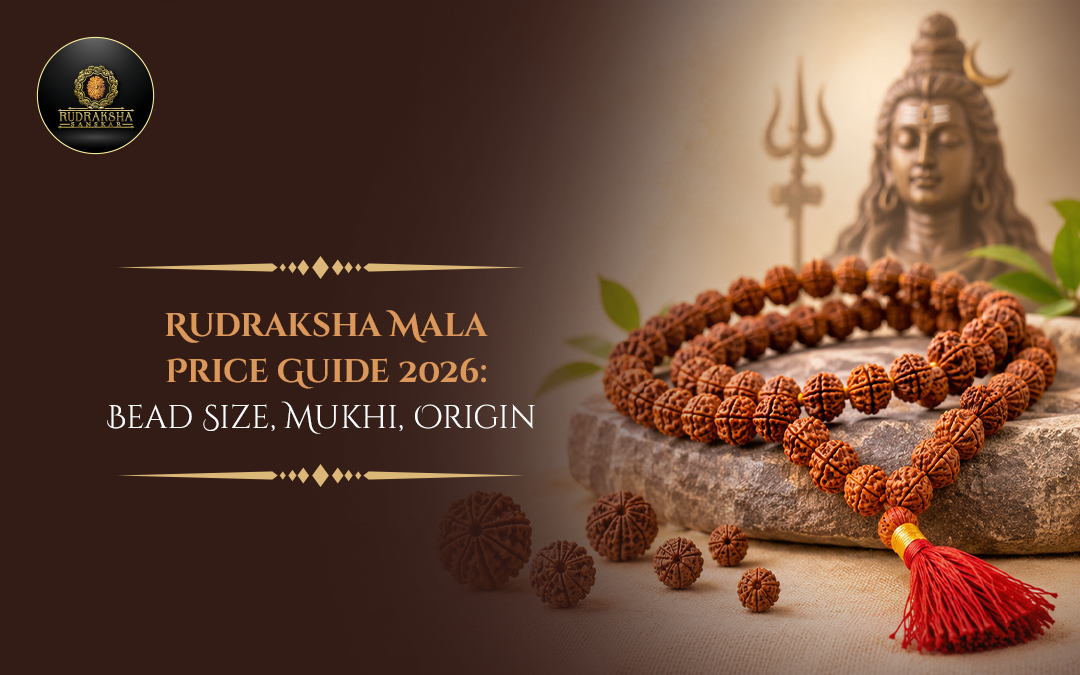
Rudraksha malas are widely used for mantra Japa, meditation and devotional practices, particularly among followers of Lord Shiva. However, anyone planning to purchase one will quickly notice that prices vary considerably.
A simple 5 Mukhi Rudraksha mala may cost a few hundred rupees, while premium Nepali malas and rare higher Mukhi combinations can cost thousands or even lakhs.
So, what determines the Rudraksha mala price in 2026, and how much should you expect to pay?
The answer depends on several factors, including bead size, Mukhi count, geographic origin, authenticity, craftsmanship and the number of beads.
Understanding these differences can help you choose a genuine mala without paying unnecessarily for features that may not matter to your devotional practice.
This guide explains Rudraksha mala pricing in India, compares popular varieties and outlines the important checks to make before purchasing.
1. What Determines the Price of a Rudraksha Mala?
The price of a Rudraksha mala is not determined by one characteristic.
Several factors influence its final cost.
Bead Size
Larger beads often command higher prices, particularly when they are naturally formed and reasonably uniform.
Mukhi Count
Common varieties such as 5 Mukhi are generally more affordable than rare higher Mukhi beads.
Geographic Origin
Nepali and Indonesian Rudraksha can differ in size, appearance, availability and market demand.
Number of Beads
A 108-bead mala generally requires more material than a 27- or 54-bead mala.
Authenticity and Documentation
Premium specimens with credible authentication and traceable sourcing may attract higher prices.
Craftsmanship
Threading quality, bead matching, silver fittings, decorative elements and finishing can also affect the cost.
Understanding these factors is more useful than assuming every expensive mala is spiritually superior.
2. Rudraksha Mala Price in India 2026: Estimated Ranges
The following figures are illustrative Indian retail budget ranges for 2026, not verified live quotations. Actual prices can differ significantly between sellers, especially for Nepali and rare higher Mukhi products.
| Rudraksha mala type | Indicative price range |
| Basic 5 Mukhi Indonesian mala | ₹200–₹1,000 |
| Better-finished 5 Mukhi Indonesian mala | ₹500–₹2,000 |
| Small-bead Nepali 5 Mukhi mala | ₹1,000–₹4,000 |
| Medium-bead Nepali 5 Mukhi mala | ₹2,500–₹8,000 |
| Large-bead Nepali 5 Mukhi mala | ₹5,000–₹20,000+ |
| Premium or mixed-Mukhi mala | Highly variable |
| Rare higher Mukhi Siddha Mala | Potentially tens of thousands to lakhs |
These ranges are useful for preliminary budgeting, but they should be checked against current listings before making a purchase.
A mala’s exact value depends on the individual beads, their condition and the credibility of the seller.
3. How Bead Size Affects Rudraksha Mala Price
Bead size is one of the easiest characteristics to compare.
Rudraksha malas are commonly sold using measurements in millimetres.
Small Beads: Approximately 4–7 mm
Small-bead malas are generally lightweight and convenient for everyday Japa.
Many Indonesian Rudraksha malas fall into this size category.
Their compact dimensions make them suitable for people who prefer a less bulky mala.
They are often among the more affordable options.
Medium Beads: Approximately 8–12 mm
Medium-sized beads offer a balance between visibility, handling and comfort.
Some devotees prefer this size because the beads are easier to move individually during mantra recitation.
Pricing depends heavily on origin and quality.
Large Beads: Approximately 13–20 mm or More
Large Rudraksha malas are visually prominent and may be preferred by collectors or devotees seeking a particular traditional appearance.
Large, reasonably uniform Nepali beads can command premium prices.
However, bigger does not automatically mean better.
A genuine smaller mala may be more practical for regular Japa than a heavy, expensive alternative.
Does Bead Size Change Spiritual Benefits?
There is no reliable scientific evidence that larger Rudraksha beads produce stronger spiritual effects.
Size primarily affects appearance, comfort, weight, availability and market price.
4. Nepali vs Indonesian Rudraksha Mala Price
Geographic origin plays an important role in how Rudraksha malas are marketed.
Two commonly discussed origins are Nepal and Indonesia.
Nepali Rudraksha Mala
Nepali beads are often comparatively larger and have more prominent surface ridges.
Large, well-matched Nepali malas can be expensive because assembling a full strand of similar natural beads requires careful selection.
Premium Nepali specimens may also attract collector demand.
Indonesian Rudraksha Mala
Indonesian beads are often smaller, with finer surface features.
They are commonly used in lightweight Japa malas.
Many Indonesian 5 Mukhi malas are available at affordable prices, making them practical for beginners.
Price Comparison
| Factor | Nepali Rudraksha mala | Indonesian Rudraksha mala |
| Typical appearance | Larger, prominent ridges | Smaller, finer texture |
| Weight | Often heavier | Often lighter |
| Common pricing | Generally higher | Generally more affordable |
| Daily Japa | Suitable | Suitable |
| Authenticity | Must be verified | Must be verified |
| Spiritual superiority | Not established | Not established |
Both origins can produce genuine Rudraksha.
Origin alone does not determine the religious value of a mala.
5. How Mukhi Count Influences Mala Pricing
Mukhi refers to the natural facial divisions on a Rudraksha bead.
Different Mukhi patterns have different levels of availability.
5 Mukhi Rudraksha Mala
The 5 Mukhi Rudraksha is one of the most widely available varieties.
It is traditionally associated with Kalagni Rudra, a form of Lord Shiva.
Because 5 Mukhi beads are relatively common, malas made from them are generally affordable.
They are widely used for mantra Japa and daily devotional practice.
6 Mukhi Rudraksha Mala
The 6 Mukhi Rudraksha is commonly associated with Lord Kartikeya.
Its price depends on the origin, size and quality of the beads.
A complete mala made from genuine 6 Mukhi specimens may cost more than a comparable 5 Mukhi mala.
7 Mukhi Rudraksha Mala
The 7 Mukhi Rudraksha is associated with Goddess Mahalakshmi in several contemporary traditions.
Its price varies according to the individual beads and their availability.
Higher Mukhi Malas
Malas containing rare varieties such as 14 Mukhi, 18 Mukhi or 21 Mukhi can become significantly more expensive.
However, buyers should distinguish between a mala made entirely from a particular Mukhi and a mala containing only one rare bead.
For example, a 5 Mukhi mala with one premium 14 Mukhi bead is not the same product as a complete 14 Mukhi mala.
The number and type of rare beads must be clearly stated.
6. What Is the Price Difference Between 27, 54 and 108 Bead Malas?
Rudraksha malas are available in different bead counts.
27-Bead Mala
A 27-bead mala is compact and convenient for carrying.
Some practitioners use it for shorter Japa sessions or count four rounds to complete 108 repetitions.
54-Bead Mala
A 54-bead mala is another practical option.
Two rounds can be used to count 108 mantra repetitions.
108-Bead Mala
A 108-bead mala is widely used in Hindu devotional traditions.
Many malas also include an additional Guru or Meru bead, which is generally not counted among the 108 Japa beads.
Does More Beads Mean a Higher Price?
Usually, a mala containing more comparable beads requires more material and labour.
However, the final price also depends on size, origin, craftsmanship and Mukhi count.
A 27-bead mala made from rare premium specimens may cost substantially more than a standard 108-bead 5 Mukhi mala.
7. Why Are Some Rudraksha Malas Extremely Expensive?
Certain Rudraksha malas command exceptionally high prices because they contain rare natural specimens.
One example is the Siddha Mala.
A traditional Siddha Mala may include a combination of different Mukhi varieties, although the exact arrangement depends on the tradition and seller.
Some products feature a sequence from 1 Mukhi to 14 Mukhi.
You can explore the 1 to 14 Mukhi Rudraksha Siddha Mala guide to understand its composition.
What Makes Siddha Mala Expensive?
The price may reflect:
- Rare individual Mukhi varieties
- Difficulty sourcing genuine specimens
- Matching and assembly
- Authentication requirements
- Collector demand
A premium Siddha Mala should come with clear documentation identifying its important beads.
High pricing alone is not proof of authenticity.
8. Original vs Fake Rudraksha Mala: Does Price Reveal Authenticity?
Price cannot reliably establish whether a Rudraksha mala is genuine.
An affordable mala may contain authentic common beads.
An expensive mala may still include modified or misrepresented specimens.
What Should You Check?
Natural Mukhi divisions: Examine whether the facial lines appear naturally formed.
Bead consistency: Check whether the mala contains the Mukhi type advertised.
Actual product photographs: Request clear images rather than relying only on generic catalogue pictures.
Seller transparency: Review information about origin, bead size and construction.
Authentication: For expensive varieties, request specimen-specific documentation.
Avoid relying on floating tests or copper-coin demonstrations.
Read how to identify an original Rudraksha for a detailed explanation.
9. How to Choose the Best Rudraksha Mala for Your Budget
The right mala depends on your intended use.
Budget-Friendly Choice
A genuine 5 Mukhi Indonesian mala can be a practical option for beginners.
It is generally lightweight and suitable for daily mantra Japa.
Mid-Range Choice
A well-made 5 Mukhi Nepali mala may appeal to buyers who prefer larger beads and more prominent natural texture.
Premium Choice
Collectors and experienced devotees may consider large Nepali beads, rare Mukhi varieties or a documented Siddha Mala.
However, expensive products should be evaluated carefully.
What Matters More Than Price?
Prioritise authenticity, comfort, appropriate bead size and transparent product information.
A comfortable, genuine mala that you regularly use may be more suitable than an expensive mala purchased solely because of its rarity.
10. Common Mistakes When Buying Rudraksha Mala Online
Many buyers make avoidable mistakes when comparing prices.
Comparing different bead sizes: A 5 mm mala and a 15 mm mala are not directly comparable.
Ignoring origin: Nepali and Indonesian products often have different market pricing.
Overlooking bead count: Confirm whether the product contains 27, 54 or 108 beads.
Confusing a combination mala with a single-Mukhi mala: Check the actual composition.
Trusting guaranteed benefit claims: Rudraksha does not have scientifically proven powers to guarantee wealth, health or professional success.
Paying a premium without documentation: Rare specimens require stronger verification.
Always compare products using similar specifications.
Conclusion
The price of a Rudraksha mala in 2026 depends on several factors, particularly bead size, Mukhi count, geographic origin, bead count and authenticity.
Small Indonesian 5 Mukhi malas are often affordable, while large Nepali malas and rare higher Mukhi combinations can command premium prices.
However, expensive does not automatically mean better.
For daily mantra Japa, an authentic and comfortable 5 Mukhi mala may be entirely suitable.
If you plan to buy rudraksha online, compare bead specifications, request clear product information and prioritise authenticity over exaggerated claims.
FAQs
Basic 5 Mukhi malas may be budgeted from a few hundred rupees, while larger Nepali malas and rare combinations can cost considerably more. Actual prices depend on size, origin, Mukhi count and seller.
Nepali beads are often larger, and well-matched strands can attract premium pricing because of availability, appearance and collector demand.
A genuine 5 Mukhi mala is commonly recommended for beginners because it is widely used in Shiva worship and generally affordable.
Both can be used for mantra Japa. The main differences involve bead count, length, handling and the number of rounds needed to complete 108 repetitions.
There is no reliable scientific evidence that price determines spiritual effectiveness. Higher prices generally reflect physical characteristics, rarity and market demand.